
How to adjust the clearance of the cone crusher
A cone crusher’s crushing gap is known as Closed Side Setting (CSS), a vital parameter that directly impacts discharge particle size, production output, liner wear and machine load. Two common types are used on-site: multi-cylinder hydraulic cone crushers (HP/HPT series) and spring mechanical cone crushers. All CSS adjustments must follow lockout-tagout safety protocols. Operators are never allowed to adjust the gap while the machine is loaded, as this will cause oil system breakdown, thread damage and liner cracking.
Before adjustment, fully power off the crusher, post warning signs and wait for the eccentric assembly to stop completely. Bleed residual hydraulic pressure for hydraulic models, and prepare lead bars, tape measures and heavy-duty spanners. The lead bar squeeze method is the standard field measurement: place four identical lead bars evenly around the crushing cavity, rotate the mantle by hand to flatten them, then average the thinnest thickness of the four bars for accurate CSS. Single-point readings always lead to errors. Set target CSS based on production needs: use smaller gaps for fine aggregates and larger gaps for high-capacity coarse crushing. Do not go below the minimum safe gap labeled on the machine nameplate to prevent metal-to-metal impact between moving and fixed liners.
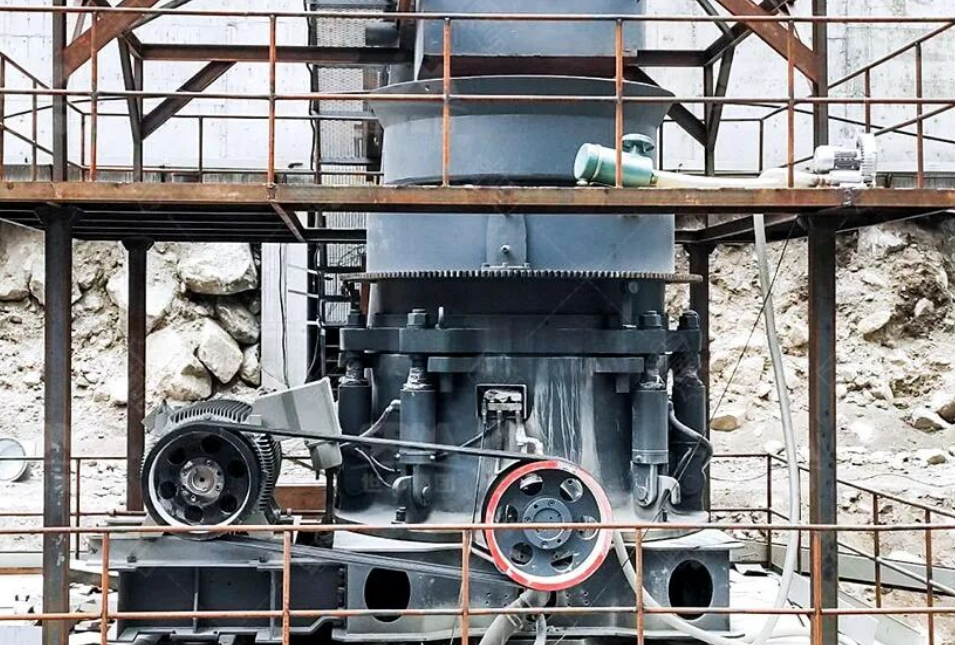
For hydraulic cone crushers, shift the tramp release cylinder to manual mode and start the hydraulic pump to stabilize oil pressure. Retract locking cylinders to unlock the adjustment ring, which controls CSS height. Raise the ring to narrow the gap and lower it to widen the gap. Only make small incremental changes; drastic one-off adjustments cause uneven liner wear. Re-measure CSS with lead bars after each tweak. Once the target gap is achieved, lock the cylinder, shut down the pump and switch back to automatic protection mode. The automatic system lifts the mantle automatically to discharge tramp iron and avoid equipment damage during overload. New hydraulic models support offline minor gap tweaks, which require a short no-load test run to check particle quality.
Spring cone crushers adjust gaps via serrated adjustment ring threads. Loosen surrounding spring bolts diagonally to release even preload first. Turn the ring clockwise to shrink CSS and counterclockwise to expand it, and recheck lead bar thickness after every half turn. Retighten spring bolts diagonally post-adjustment to avoid support ring bouncing and uneven liner abrasion. Liners wear gradually in daily operation, widening CSS. Minor clockwise ring adjustments every 2-3 days offset normal wear. Replace liners immediately if two full rotations fail to restore qualified CSS.
After adjustment, run the crusher empty for 5-10 minutes to check odd noise, vibration and oil leaks, then conduct low-rate trial feeding. Too small CSS triggers motor overload and fast liner wear, while excessive CSS causes oversized stones and lower throughput. For hard materials like granite and iron ore, slightly reduce eccentric throw to stabilize CSS. Lubricate adjustment threads regularly to prevent seizing, and record gap, wear and operating data in maintenance logs to extend equipment service life.
- What equipment is used to crusher stone into sand?
- How to configure a 300 TPH sand production line?
- How much does a sand making production plant cost?
- What are the differences between an impact crusher and a cone crusher?
- Which type of sand making machine for stone is better?
- How to improve the production efficiency of sand making equipment?