
What equipment is used to crusher stone into sand?
The process involves primary crushing, secondary and tertiary crushing, sand making, screening, and washing, with core and auxiliary equipment working in coordination. The mainstream crushing equipment is as follows:
Core Crushing & Sand Making Equipment
Jaw Crusher (Preferred for Primary Crushing)Mainly processes large raw stones (≤1200mm). It crushes boulders into 100–350mm particles through the reciprocating squeezing motion of the moving jaw and fixed jaw. Suitable for hard and soft stones such as granite, basalt, and limestone, it is essential for the first stage of production lines.
Cone Crusher (Secondary & Tertiary Crushing · High-Hardness Materials)Adopts the laminated crushing principle, squeezing and grinding materials via tapered liners. Ideal for high-hardness and highly abrasive stones such as basalt and granite. It produces finished particles with regular shape and low flakiness content, and features low wear on wearable parts. Commonly used for secondary or tertiary crushing.
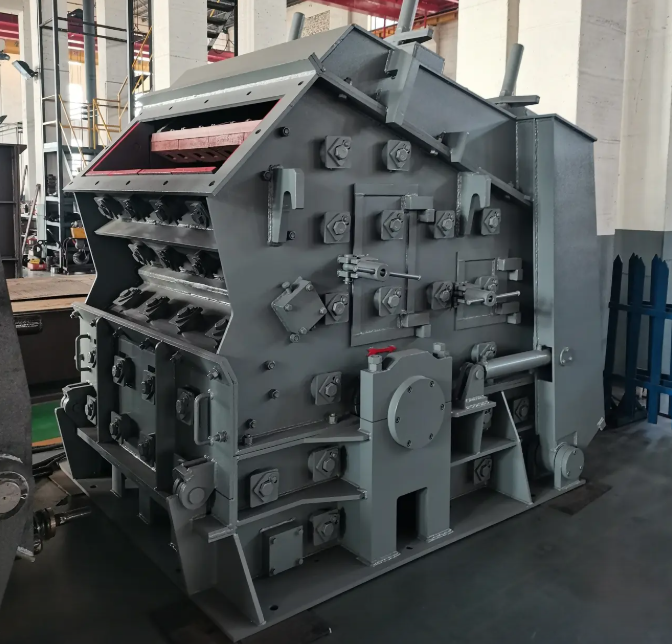
Impact Crusher (Secondary & Tertiary Crushing · Medium-Soft Materials)Crushes materials through high-speed impact of blow bars and collision with impact plates. It features a large crushing ratio and excellent particle shape, better suited for medium-low hardness materials such as limestone and bluestone with low cost. However, wearable parts wear rapidly when processing high-hardness materials.
Vertical Shaft Impact Sand Maker (VSI Sand Maker) (Core Sand Making Equipment)Operates on the “stone-on-stone” or “stone-on-iron” principle. A high-speed rotor (60–75m/s) hurls stones to collide and grind against each other, converting 0–55mm aggregates into 0–5mm manufactured sand. The finished sand has a round particle shape, reasonable gradation, and adjustable fineness modulus (2.6–3.0), meeting national standards for construction sand, making it the mainstream equipment for high-quality manufactured sand.
Double-Roller Sand Maker (Small-Scale · Medium-Soft Materials)Works via the relative rotation, extrusion, and shearing of two rollers. It has a simple structure, low cost, and low dust generation. Suitable for medium-low hardness and high-moisture materials such as limestone and gangue, it is mostly used in small production lines or fine grinding.
Hammer / Vertical Shaft Hammer Sand Maker (Simplified · Short Process)Crushes materials via high-speed hammer impact, enabling one-step forming and eliminating multi-stage crushing. Suitable for small-scale and low-cost scenarios, but hammers wear quickly and have a short service life when processing high-hardness materials.
Mobile Sand Making Machine (Mobile Crushing Plant)Integrates feeding, crushing, sand making, screening, and conveying in a single unit, available in wheeled or crawler-mounted versions. It allows flexible relocation, requires no infrastructure construction, and operates on-site with raw materials. Ideal for scenarios such as scattered raw material sources, temporary construction sites, and construction waste recycling.
- Which is better for sand making: impact crusher or cone crusher?
- What are the types of granite sand making machines?
- What are the differences between an impact crusher and a cone crusher?
- How many tons of stone can a cone crusher process per day?
- Which type of sand making machine for stone is better?
- Complete Equipment for 500TPH Sand Making Plant