
What equipment is used for basalt gravel production?
Basalt features high hardness, strong wear resistance and excellent compressive performance, making it a high-quality raw material for infrastructure aggregates. However, due to its compact texture and high brittleness, its crushing and processing impose extremely high requirements on equipment wear resistance and crushing force. A standardized basalt gravel production line shall be equipped with primary crushing, secondary and fine crushing, screening, shaping, dust removal and conveying auxiliary equipment to realize standardized processing from raw stone to finished aggregates.
For primary coarse crushing, the jaw crusher is the core choice. Designed for large basalt raw stones, this equipment relies on the extrusion and occlusion between the moving jaw and the fixed jaw to efficiently handle large raw stones with a diameter of 500mm–1000mm. It delivers strong compressive crushing force, and its wear-resistant jaw plates are suitable for processing high-hardness rocks, ensuring uniform and stable discharge particle size. Featuring a sturdy structure and low failure rate, it can withstand the impact force generated by high-intensity basalt crushing. As the core equipment in the first stage of the production line, it mainly crushes large raw stones into medium-sized stones of 200mm–300mm, laying a foundation for subsequent fine processing.
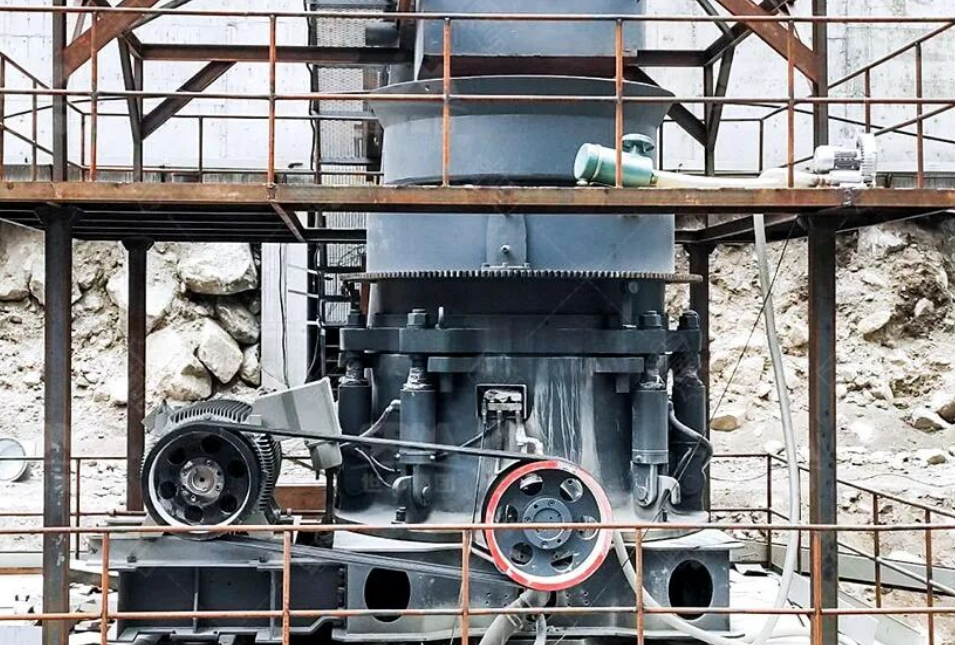
For secondary and fine crushing, the cone crusher is the preferred core equipment. The hardness of basalt is far higher than that of ordinary limestone, so impact crushers suffer from rapid wear and insufficient capacity. In contrast, the cone crusher adopts the laminated crushing principle, grinding stones through extrusion between the concave and the mantle, which is specially adapted to high-hardness basalt. This machine has good sealing performance and durable wear-resistant parts, enabling precise control of discharge particle size. It can process coarsely crushed stones into standard gravel of 10mm–50mm, with the advantages of large output, low dust emission and regular finished product edges. As a special main equipment for basalt secondary and fine crushing, it is often equipped with a multi-cylinder hydraulic model for convenient particle size adjustment and blockage clearing.
Gravel shaping and screening equipment includes vertical shaft impact crushers (VSI sand makers) and circular vibrating screens. Vertical shaft impact crushers are mainly used for fine shaping. Using the rock-on-rock or rock-on-steel crushing principle, they correct the edges and corners of basalt gravel, optimize particle gradation, and improve the roundness of finished aggregates to meet high-standard material requirements for expressways, high-speed rail and other infrastructure projects. Circular vibrating screens perform classification and screening. Through multi-layer screens, stones are separated into finished products of different specifications such as 5–10mm, 10–20mm and 20–30mm. Unqualified large materials are returned to the crusher for secondary processing to ensure uniform finished particle size.
The production line needs to be equipped with auxiliary supporting equipment. Belt conveyors are responsible for stone transportation between equipment to realize automatic continuous production; feeders feed materials evenly and quantitatively to prevent crusher blockage and overload operation; pulse dust removal equipment strictly controls processing dust to meet environmental protection emission standards; sand washers can clean impurities and stone powder on the surface of finished gravel to improve aggregate cleanliness. In addition, some production lines are equipped with mobile crushing stations, which integrate crushing, screening and conveying functions, suitable for scattered operations in field mines and flexible site transfer.
With a scientific configuration, the complete set of basalt gravel production equipment is connected layer by layer from coarse crushing, secondary crushing to shaping and screening. It not only adapts to the high-hardness characteristics of basalt, but also ensures finished product quality and production efficiency, taking into account environmental protection and automation. It is widely used in aggregate processing scenarios such as road construction, bridge engineering and concrete batching plants.
- What equipment is used to crusher stone into sand?
- How to configure a 300 TPH sand production line?
- Which is better for sand making: impact crusher or cone crusher?
- What are the complete stone crushing plant equipments?How much is a complete crushing production line?
- How much does a sand making production plant cost?
- What are the differences between an impact crusher and a cone crusher?