
Impact crusher for secondary crushing or fine crushing?
Impact crushers are one of the most widely used machines in the mining crushing industry. They work well for both secondary crushing and fine crushing, serving as all-in-one crushing equipment with dual functions. They are widely applied in sand and gravel production lines, ore processing, construction waste recycling and many other scenarios. Compared with jaw crushers and cone crushers, impact crushers offer more flexible performance in secondary and fine crushing, and produce better-shaped finished aggregates.
In terms of crushing application positioning, the impact crusher is mainly designed for secondary crushing while also supporting fine crushing. The standard mining crushing process includes three stages: primary crushing, secondary crushing and fine crushing. Jaw crushers are mostly used for primary crushing to handle large raw stones. The impact crusher mainly takes charge of the secondary crushing after the jaw crusher. It can break stones of 100–300mm down to 20–80mm, meeting the standard requirements for road base materials and ordinary aggregates, and it is the core equipment for the secondary crushing section in production lines.
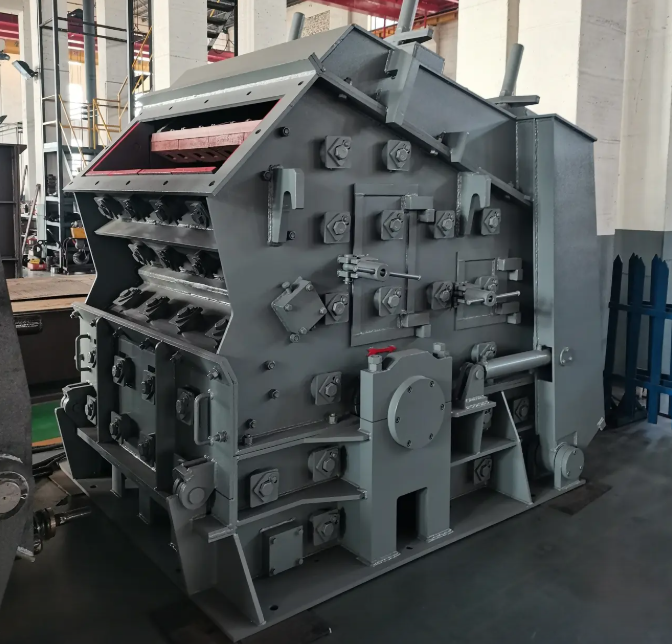
With proper parameter adjustment, the impact crusher can also finish fine crushing efficiently. By adjusting the gap of impact plates, rotor speed and feeding size, it can process materials into fine aggregates of 5–20mm, and even make semi-finished manufactured sand.
Compared with cone crushers which are professional in fine crushing, impact crusher finished products have clear edges, round particle shape and very low flaky particle content. No secondary shaping is needed, making it ideal for high-grade concrete and asphalt road materials. Its downside is higher wear when crushing hard rock in fine crushing. It is more suitable for medium and low hardness materials such as limestone, granite and basalt.
We can clearly define its positioning by comparing with other crusher models: jaw crushers are only fit for primary crushing and not good at fine crushing; cone crushers are more for hard rock secondary and fine crushing with average particle shape. The biggest advantage of impact crushers is being the main machine for secondary crushing and compatible with fine crushing, with strong versatility.
In small and medium-sized sand and gravel plants and mobile crushing stations, one impact crusher can often replace two separate machines for secondary and fine crushing. It simplifies the production process and reduces equipment investment and maintenance costs.
Impact crushers are suitable for brittle and medium-hard materials, but not suitable for long-term fine crushing of ultra-high hardness ores. It runs stably for secondary and fine crushing of limestone, coal gangue, construction waste, weathered rock and similar materials. For high-hardness materials like river pebble and iron ore, cone crushers are preferred for fine crushing, while impact crushers are only used for secondary crushing to reduce wear and consumption of blow bars and liner plates.
- Which Crusher is Best for Processing Aggregates?
- How to configure a 300 TPH sand production line?
- What equipment is used for basalt gravel production?
- What are the complete stone crushing plant equipments?How much is a complete crushing production line?
- How much does a sand making production plant cost?
- Which type of sand making machine for stone is better?